

Speechless in Svalbard
Losing and Finding My Arctic Lexicon
Going to the Arctic with my 86-year-old mother was not something I’d ever anticipated. Not because my mom and I haven’t done some serious travel in our time, because we have. China. East Africa. Turkey. Panama. The Galapagos. But given Mom’s age and accompanying anxieties—stairs, swelled ankles, misplaced medication, falling—I figured her days of adventure travel were over. Imagine my surprise when I find out Mom’s booked me and my sister, along with herself, on a 12-day expedition cruise through the polar seas of the Norwegian Arctic.
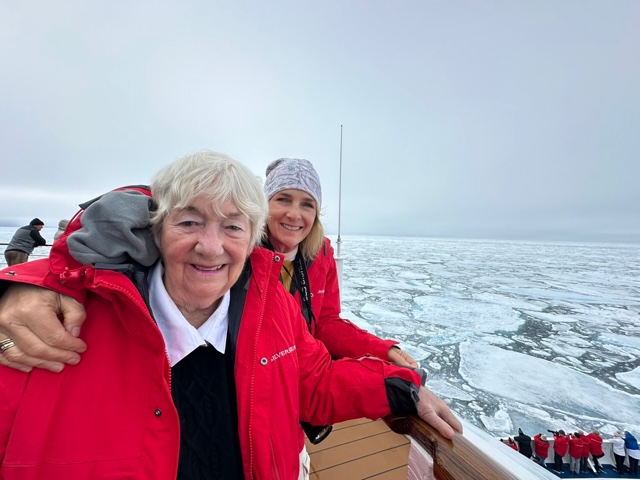
“Mom!” I say, after reviewing the itinerary which has us cruising the remote fjords of Svalbard, a Norwegian archipelago in the Arctic Ocean. “You realize this involves Zodiac travel—as in climbing into a rubber boat and sitting there in the cold.” I show her a map of where we’re going. Barren in summer, glacial in winter, the cluster of islands shares the topographical profile of a mangled slice of pizza someone’s ripped apart, leaving cheesy strings of land. “How’s that going to work?” My mom fights me over walking down her front doorsteps.
“If I can’t do it, I can’t do it,” she says flatly. “I’ll stay on the ship and you two can report back.”
Mom did end up riding in a Zodiac but not until one of our last days on the ship. In the intervening period, my sister and I were required to report back, something that proved much harder than I could have ever imagined.
The whole time I was in the Arctic I found myself at a linguistic loss. While my sister, Hilary, posted daily updates to her Instagram and Facebook feeds, I kept my silence. Online and sometimes even with Mom.
What was wrong with me? I was in the storied arctic, seeing storied animals, sounding like someone making a road trip up the desolate flatlands of California’s I-5.
Hilary and I would return from an excursion and pull out our phones and cameras. Try as I might to describe what I had seen and heard and felt, everything I said came out sounding flat, dull, and cheerless. What was wrong with me? I was in the storied arctic, seeing storied animals, sounding like someone making a road trip up the desolate flatlands of California’s I-5.
Take my conversation with Mom following our first polar bear sighting in Forlandet National Park. My sister and I saw two bears — the first one? Sleeping. Not much to report there. The second bear was the real showstopper. Not that you’d know that from what passed between Mom and me, which went something like this:
Mom: “You saw a polar bear?”
Me: “Hmmm. Big one.”
Mom: “What was it doing?”
Me: “Walking and swimming, snacking on a seal in the water. Watching us.”
Mom: “And?”
Me: “It was uhm –”
I can’t remember what word I used to describe seeing the largest living of species of bear on earth except that it was inadequate. There’s nothing in the settled world that can be likened to seeing a polar bear, in its natural state, living if not its best life, then certainly its most essential life.
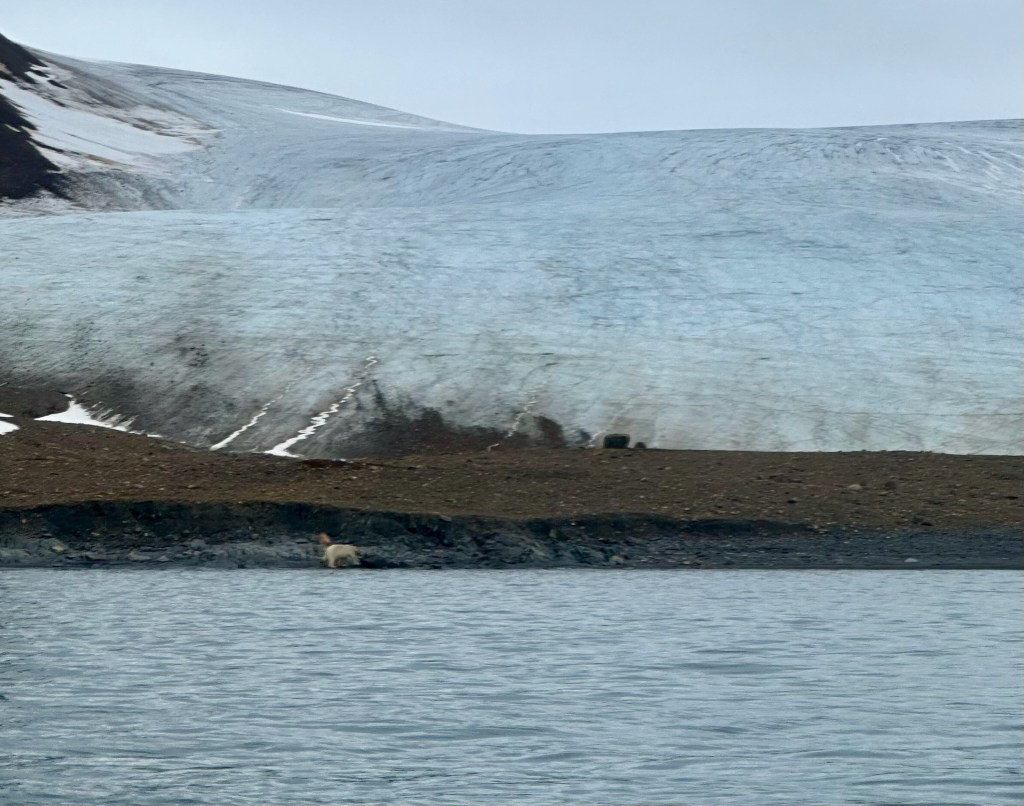
Preoccupied with its meal and water play, the bear initially ignored our tiny regatta of Zodiac boats circling in carousel formation from a distance. As I explained to my mother, the Norwegian government mandates zodiac guides maintain at least 400 meters of space between Arctic wildlife, to keep everyone, including the bear, out of harm’s way. (This also explains why close-up photos are next to impossible without high-end camera equipment, which I don’t have). The naturalist guiding our boat said because bears don’t count, our idling black rubber Zodiac with its eight red-jacketed inhabitants, likely appeared to the bear as a singular being. Seemly unconcerned with us at first, the bear eventually found us to be of some concern and froze—a cue that prompted our guide to motor us quietly away.
What I didn’t tell Mom then, that I will share with you now, was how it felt to be stared down by that giant white bear, even at a distance. Its posture—head and shoulders frozen above the waterline—suggested a warning but also something else; a telepathic message that says, “I’m watching you, watching me. Why are you here?”
Why indeed.
Polar trips are big bucket list, life events that some among us are lucky enough to experience. It’s only because of my ship-locked, detail-starved mother that I saw that endangered polar bear—and that trio of adolescent walruses? on a beach. Oh yes, and the humpback whale with its glistening black tail fluke, broad as a goal post.
This gifted trip from my mother near the end of her life seems too generous not to be shared, thus I’m going to give my arctic word search one more pass.
Sitting here at my desk on this late September in overheated California, some 2,600 miles away, I allow myself to be transported back to the ship’s deck where I stood on many occasions taking in the views, under changing skies.

Expansive is the first word that comes to mind. Why I didn’t think of this word back in July, I have no clue. But here it now; the perfect descriptor for a place as wide in geographic scope as it is steeped in earthly knowledge.
The Arctic is all about expansiveness—expansive water, expansive ice, expansive land masses punctuated by stark volcanic peaks and barren plains. With air traffic almost non-existent, the sky is particularly expansive, too.
Primordial—a word that means to exist from the beginning—also comes to mind as I stare out my window at my neighbor’s home, which most certainly did not exist in the beginning. Or even 100 years ago.
Not the Arctic. This is the top of the planet we’re talking about, the place where all our longitudinal beginnings originate. Ice, the dominant element even in summer, caps mountains and carpets glacial valleys. I am reminded now of the glacier I floated beside in Nordre Isfjorden, a watery inlet cut deep inside of Spitsbergen Island, in Svalbard’s western region. Stories high and thickened over centuries, the glacier reminded me of a time capsule, the original time capsule, the one left behind by a much younger, hopeful Earth. Sheeted, stacked, compressed over the ages, Arctic ice appears so solid, it’s easy to forget that it is millions of square meters of frozen water, frozen water that is melting at record speed.
To witness so much frozen water in one place and to watch it melt is sobering—another fine word I will now add to my Arctic lexicon.
I will never forget the day Mom and I stood on the deck of our ship in chilly silence, staring down at the place where open sea ends and the Arctic ice cap begins, 565 nautical miles from the tippy top of the world. In spring and summer, this fragile boundary line some spreads fractures into floating jigsaw pieces of melting ice that come winter will freeze together or so we hope. This being July, the melt off was at its height. A fantastical sight to rival anything Game of Thrones could offer; all I could think of was the endless summer to come and the rising seas that would follow.
Sobering need not be a buzz kill. In my humbled state, I found much to celebrate in the Arctic.
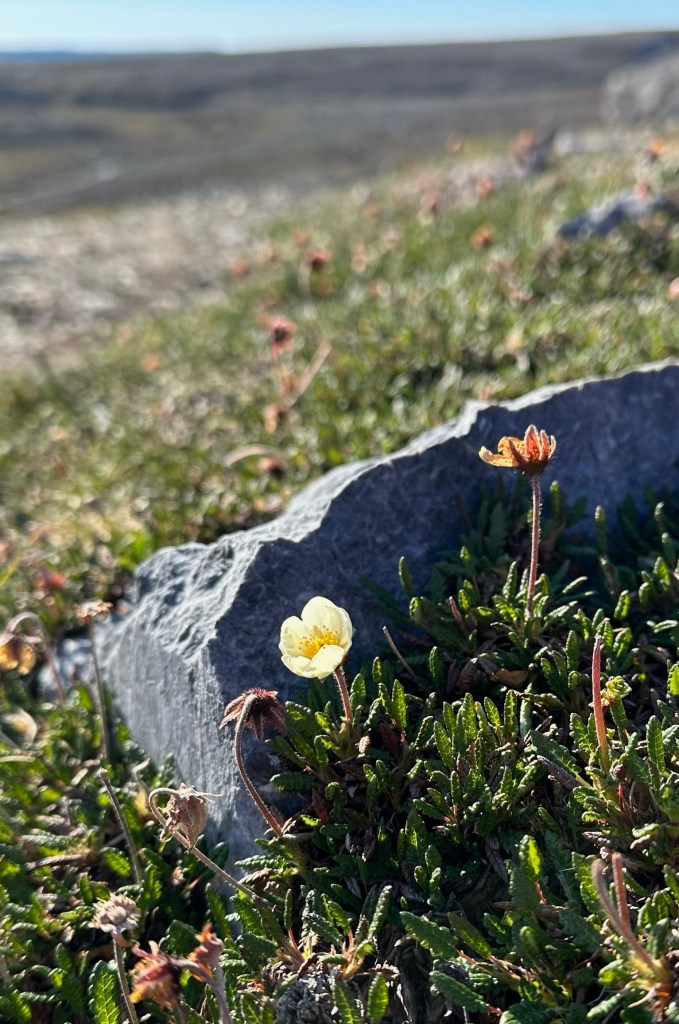
Flowers like the Arctic Poppy and Purple Saxifrage, so small and smart and practical, adapted not just for survival but propagation. Perhaps that we humans might achieve the same in the face of our changing climate?
To witness a puffin in flight, with its ridiculously small wings and indomitable spirit, is to be reminded of how survival favors the determined.
A novelist preoccupied with migration themes; I am still making meaning of the Arctic terns that dotted the skies from Svalbard to Iceland during our two-week journey.
A relatively small sea bird that travels from pole to pole annually, the Arctic terns I saw will log a staggering 18,000-plus sky miles in a single year. I ask in my first (yet unpublished) novel, what they know that I don’t about displacement and survival.
A trip to the Arctic rattles the cage of human certainty. It took me two months at home to find those descriptors. But there they are. My cage rattles still.
While the polar bear follows the ice, I turn on my ceiling fan and AC. To what end? Large and powerful like the polar bear, we humans are no less sensitive to changes in the climate. I spent three days in Death Valley covering an ultra-marathon in 125-degree heat and saw the toll it took even on observers like me. This summer in my Northern California hometown it topped 106-degrees. It’s no joke, folks.
Climate scientists can talk all day long about rising sea levels. But to see firsthand the melting ice coming for us at the lower latitudes and learn how that increased water supply will affect currents and weather patterns, changes a person. It did me. Concerned as I am for that polar bear I saw, my worry for humanity is now equally urgent.

Post Note: During a day at sea, I dipped into a writing workshop led by expedition guide and South African naturalist, Jessica Oosthuyse. During the session, Jess prompted our small group to select a photo from our iPhones and write a 17-syllable Haiku about its subject matter.
In my tongue-tied, pencil stiff state, I welcomed the exercise, hoping it might loosen the vice choking my vocabulary. I selected the picture below and began sorting through words, clapping out syllables, ordering them by lines.
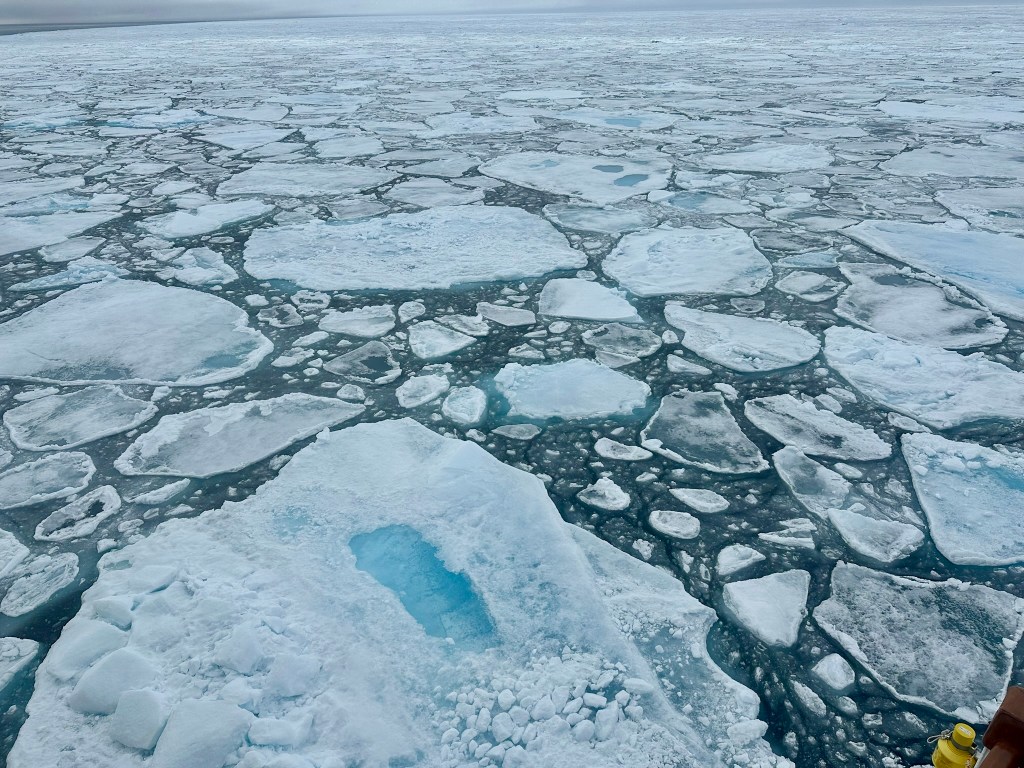
A traditional form of Japanese poetry, the Haiku formula requires the syllables be divided up into three lines in a 5-7-5 formula. Lucky for me, someone in the group had the inspired idea to suggest we be allowed to use the Tanka form as well. Like the Haiku, the Tanka poem is meant to express emotion as well as impressions while also making a statement. More generous with its syllable allowance, the Tanka’s poetic formula (5-7-5-7-7) allows for 14 extra syllables.
Even with 31 syllables, it’s not easy to convey the poignancy of the Arctic Sea ice during the summer thaw and what it might portend for those of us in the lower latitudes for seasons to come.
Phantom Frost
Summering ice split
like fractured geodes strewn north
over this polar sea
prismatic, crystalline, made
mosaic by thermal stress
